Dear Friend,
Most people think they know what Elon Musk has been up to.
The rockets and the cars. The chatbot on your phone.
But here’s what they don’t know…
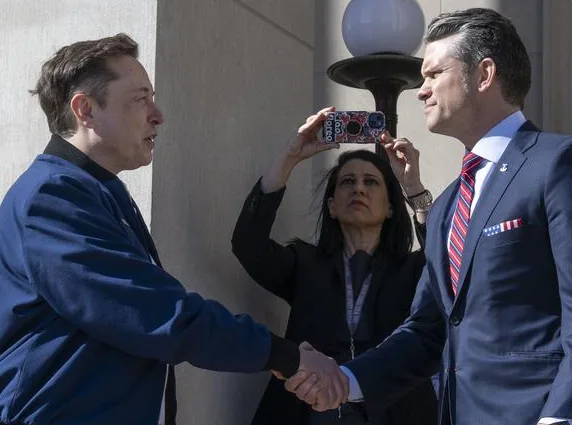
On June 15, 2026, the Pentagon’s chief AI officer walked into a federal courthouse and swore, under oath, that Elon’s AI made the Iran strikes possible.
His words:
[Elon’s AI] “enabled U.S. forces to deploy over 2,000 munitions to 2,000 distinct targets within 96 hours.”
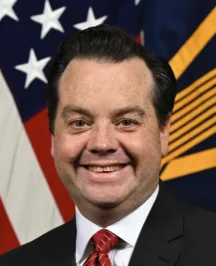
[Elon’s AI] “enabled U.S. forces to deploy over 2,000 munitions to 2,000 distinct targets within 96 hours.”
That’s one new target about every 3 minutes, around the clock, for 4 straight days.
And he swore that Elon’s data centers are “as foundational to our modern defense posture as traditional munitions production.”
Think about what that means:
A computer in Tennessee now matters as much to America’s military as bullets and missiles.
That computer is Colossus.
But there’s a problem.
A problem that gives people like me and you a limited window of opportunity to profit from the biggest Alliance of the private sector and the United States government… through a tiny company that has just forced Elon into a 7-year contract…
As I’m about to show you, last time anything like this happened… investors had the chance to snatch a gain of 12,650% in 15 months by leaping on one little-known company called Itek.
You see, Elon’s computer consumes enough electricity to be ranked the 8th largest city in the country by power usage alone.
According to the Department of Energy, he would have had to wait 5 years to connect to the U.S. electrical grid.
So he went around them.
He used a legal loophole to create his own, temporary private energy grid for Colossus… and turned it on in 122 days.
Elon’s computer consumes enough electricity to be ranked the 8th largest city in the country by power usage alone.
5 YEARS
The wait to connect to the U.S. electrical grid
122 DAYS
How fast Elon turned on his own grid
He ran it for almost a year before “civil-rights” groups tried forcing him to shut it down.
They got the State of Mississippi to give him until August of 2026 – and the loophole he used was officially closed.
And then something happened that I have never seen in 30 years on and around Wall Street.
The United States government walked into federal court on Elon’s side.
Not with a letter, and not with a statement.
The third-highest ranking official at the Justice Department, Associate Attorney General Stanley Woodward, personally stepped in.
In the interest of national security, the Department of Justice filed to take over the lawsuit and kill it.
Here is how the government described the case, word for word.
The lawsuit against Elon’s secret grid...
“Threatens American national, economic, and energy security by seeking to shut off the power supply for artificial-intelligence innovation that supports the Department of War’s military operations.”
— Stanley Woodward, Associate Attorney General

When the judge balked, Washington took it to the Fifth Circuit Court of Appeals.
I want to be crystal clear with you – this has never happened before.
Period.
Not once in American history.
The former head of enforcement at the EPA called it “unprecedented.”
A former chief of the Justice Department’s environmental enforcement called it a “sweeping change in the way enforcement works.”
In plain English, nobody can find a case where the federal government went to court to keep a private power plant running.
Now it has, for Elon’s little-known energy project.
A project that will go from temporary… to permanently switched on starting December 11th.
There’s even a codename for it.
It’s called the X-Grid.
As you’ve just seen – Washington now considers Elon’s X-Grid so critical to America’s defense… they consider interfering with it a threat to national security.
And this unprecedented level of government protection has opened a brief window of opportunity for investors to mint a fortune.
You see, Elon isn’t building the X-Grid alone.
There is a small, publicly traded company that has locked-in a 7-year contract with Elon to build the X-Grid’s permanent power generation.
Today I’m going to give you the details on that company.
And I’m going to show you why I believe the X-Grid has become the single biggest investment opportunity of our time.
I’ll show you why the X-Grid isn’t a side item on the ledger.
Justice Department lawyers told the court that losing it would “clearly, and irreparably” harm America’s military capabilities.
In short, it has become the backbone of the most powerful Alliance between the government and the private sector our generation has ever seen.
I believe Colossus has become the start of a seventh branch of the United States military.
And it relies on the X-Grid to survive.
Washington is not going to let it fail. Its own lawyers said so.
I believe the company underneath it could hand early investors gains of 1,000% or more over the next 12 months. And you can be positioned before December 11th, the day the Pentagon’s hands come untied.
or more over the next 12 months
But first, let me be clear about what this is NOT.
Your Second Chance Begins
Right Now
It’s NOT about buying SpaceX after its record IPO.
It’s NOT about Grok, the chatbot you can download on your phone.
And it’s NOT about how fast Elon built Colossus.
This is about what Colossus is really for, and the one company that fuels it, now that Washington has gone to court to keep it running.
So here’s what I’m going to do for you today.
First, I’ll show you what happens to the companies Elon needs. Every time he’s needed something, the company that supplied it has run, and I’ll show you the numbers.
Then I’ll show you Elon’s new partner, the United States government, and what it does when it decides it needs something.
Every time, the company it turned to got privileges nobody else had, and handed investors a fortune in the process.
Then I’ll show you how to get in… Through one small company that supplies the X-Grid, a company you can own with a few clicks in any brokerage account.
And I’ll explain why you have to be in before December 11th.
But before we get into all of that, you deserve to know who’s telling you this.
The Former Wall Street Insider
My name is Dylan Jovine.

I grew up on food stamps in Queens, New York.
I had no trust fund, no connections and no Ivy League diploma.
A legendary banker named Peter Jacquith, the man who helped save New York City from bankruptcy in the 1970s, took a chance on me when nobody else would. By the time I was 24, I’d built my own brokerage firm at 100 Wall Street.

As founder and CEO, I moved more than $1 billion across the market… until I sold the firm and retired before the age of 50.
Today, more than 500,000 investors across 28 countries read my research.
Not because I got lucky. Because I learned to see the pattern before the crowd does.
In 2006, I warned my readers a financial crisis was coming, while every analyst on Wall Street was still raising price targets.
“The market has no place else to go but down. It’s not a question of ‘if’ it’s a question of ‘when.’”
The investors who listened saw 459% on AutoNation.
646% on American Express.
And 700% on Starbucks.
And I’ve spent the last decade putting my readers where artificial intelligence meets national defense.
I recommended Rocket Lab at $3.80, a small rocket company building for America’s defense supply chain.
Rocket Lab: as high as 3,800%
I recommended Axon near $28.
Axon: as high as roughly 3,000%
And then there’s Palantir, which I recommended at $7.38 when Wall Street called it uninvestable.
Palantir: as high as 2,700%
Today, Palantir’s software runs Maven, the Pentagon’s AI war-fighting system. And Elon’s AI is the one Cameron Stanley swore made those 2,000 targets possible.
When the AI boom started starving America’s grid, I recommended Talen Energy, a power company sitting right in the middle of the data center electricity crunch.
Talen Energy: closed for a 91% gain
And when Jim Cramer was apologizing on TV for recommending Meta, I bought it with my own money at $100. Today it’s over $700 – a gain of 600%.
Across all my closed recommendations, my win rate is 75.2%. My average return is 35.9%.
That’s every winner and every loser, audited and published.
I’m not showing you those to brag.
I’m telling you because I believe the company underneath the X-Grid could be bigger than all of them.
And the first reason is Elon himself.
Whenever Elon Needs Something, His Suppliers Get Rich
When Elon transforms an industry, his own companies aren’t the only ones that strike it rich.
The small suppliers around him get rich too.
Look at Tesla.
When Elon signed a lithium deal with a little miner called Piedmont Lithium, the stock jumped as much as 395% in a single day.
Within months it had soared as high as 1,400%.
ON Semiconductor makes the camera sensors and power chips inside every Tesla.
It ran as high as 1,550%.
Then Elon did it again with SpaceX.
When he turned spaceflight into a business, an entire industry hitched a ride on his rockets.
Planet Labs launches its satellites on SpaceX.
From its April 2024 low to its May 2026 high, it soared as high as 3,000%.
AST SpaceMobile rides SpaceX rockets to orbit too.
From its April 2024 low to its May 2026 high, it exploded as high as 6,695%.
Just $5,000 in each of those four stocks could have grown to more than $650,000.
four stocks
could become more than $650,000$650,000
From four companies most people have never heard of.
That’s what happens when you own the companies Elon needs.
And the X-Grid is the next one in line.
This Time, Elon Has a Partner
But this time it isn’t just Elon.
This time he has a partner, one even less willing to accept failure than he is.
The United States government.
And as I’ll show you, these two forces have combined to put one small company between a $1.5 trillion Pentagon budget and a $6.7 trillion AI buildout.
A company 99% of investors have never heard of.
company
Because here’s the thing about Washington.
When the government decides it needs something, it goes to any lengths.
Since May 2025, the Department of Energy has issued 43 emergency orders to keep power plants running, including plants that were supposed to close, one of them at a cost of more than $640,000 a day.
On April 20, 2026, President Trump invoked the Defense Production Act to buy transformers, circuit breakers and grid steel, and waived the law’s own requirements to do it.
And in June 2026, Washington walked into a courtroom in Mississippi to protect Elon’s X-Grid.
In fact, they’re letting Elon take it from temporary… to permanent.
Together, on December 11th, the X-Grid switches on.
But it really became clear to me after I had dinner with Congressman Brett Guthrie, who chairs the House Committee on Energy and Commerce… the oldest legislative committee in the House of Representatives.
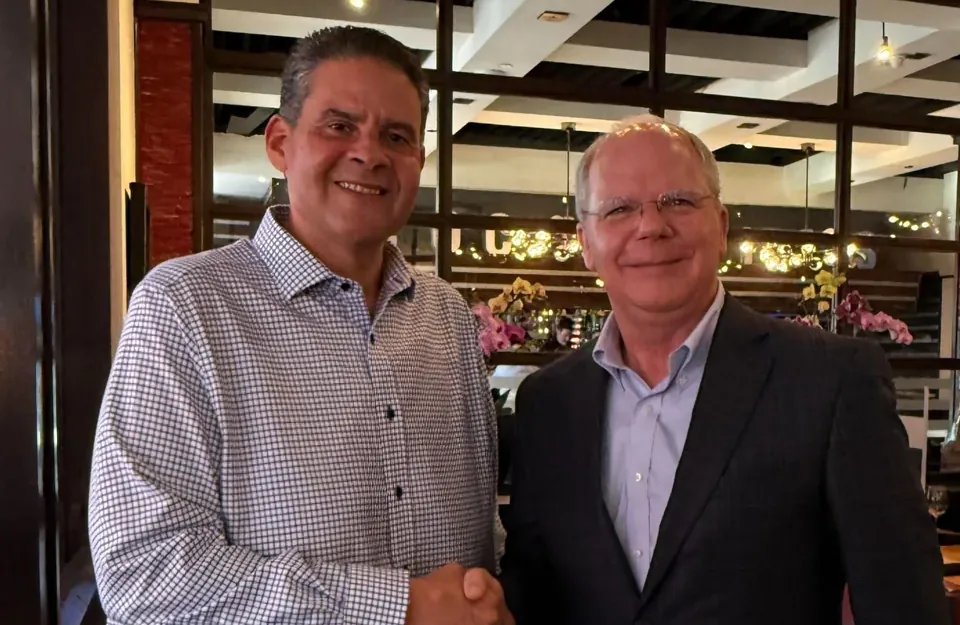
He oversees every law and policy related to business and energy in the United States.
That discussion with him led me to really understand the importance of Elon’s X-Grid…
And why President Trump himself said:
“We’re going to build electric generating facilities. I’m going to get approval under emergency declaration. I can get the approvals done myself without having to go through years of waiting.”
— President Trump

Here’s why that matters to your money:
Every time Washington has gone to those lengths, the investors in the stock who owned the ONE thing they were willing to move heaven and earth for… got rich.
Elon needs the X-Grid.
And one company has the ability to build and power it. Elon has even signed a 7-year contract with them on terms they dictated to him.
I’ll show you the details on that in a second.
But first…
The First Time Washington Went to Any Lengths
Here’s a shining example of what I’m talking about.
In September 1940, Britain was fighting for its life against German bombers.
Its scientists had just built a device the size of a small book, called a magnetron, that made radar small enough to fit in the nose of a fighter plane.
That September, Britain carried the secret to America.
Washington needed that part by the millions. For every ship and every bomber it was about to build.
Here was the bind. In 1941, America could make 17 of them a day.
Washington signed with the biggest names in the country for the weapons.
Boeing for the bombers, Chrysler for the tanks.
But the part their radar couldn’t work without came from a small Massachusetts tube maker called Raytheon.
An engineer there named Percy Spencer worked out a way to stamp the part out on a punch press, so it could be mass-produced. Production went from 17 a day to 2,600 a day.
And here’s what Washington did when it saw that. It didn’t put Raytheon in line with everybody else.
The Navy appropriated $2 million to build Raytheon, a brand-new factory in Waltham, Massachusetts.
In June 1941, it handed Raytheon a contract to put a radar on 100 of its ships.
By 1944, Boeing’s bombers were flying with radars that let them bomb through clouds, and virtually every ship in the U.S. Navy carried a Raytheon radar.
By the end of the war, Raytheon had built about 80% of every magnetron made in the war, in a factory the government paid for.
Its sales went from $3 million in 1940 to $168 million in 1945, 55 times over.
At the start of 1941, Raytheon’s thinly traded stock sold for less than $1 a share.
Raytheon: roughly 100 times your money
All told, Raytheon surged 9,980%.
Enough to turn $5,000 into about $504,000 by December 1945.
Boeing, about 90%. Chrysler, about 91%.
Raytheon, roughly 100 times your money.
Boeing had its name on the bombers.
The small supplier underneath, the one Washington built a factory for, turned $5,000 into half a million dollars.
That’s what’s happening today.
Because while Washington has thrown its weight behind SpaceX and Elon Musk…
There’s another company beneath the surface that’s going to reap the bigger windfall.
They’re being handed special permissions and approvals few if any other company in America could dream of getting… just because they are critical to the new “Alliance” between Musk and the Military.
Here’s what I mean.
When the X-Grid’s first turbines rolled into Mississippi in August 2025, the state said they wouldn’t need an air permit… thanks to a special exemption in Mississippi’s Clean Air Act plan.
The exemption allowed them to run for 12 months.
Even after the EPA closed the loophole in January, Mississippi held that its own exemption still applied.
When a civil-rights group sued, Mississippi’s governor, Tate Reeves, wrote to Washington and urged it “to take immediate action to intervene.”
Washington did, 17 days later.
The Justice Department told the court the people suing “may not pursue this Clean Air Act enforcement action over the United States’ objection.”
Mississippi’s Solicitor General, Scott Stewart, told the same court the state’s ruling “was reasonable,” and that by law the call was Mississippi’s to make.
And when the 12 months ran out, Mississippi didn’t pull the plug.
On July 30, 2026, it signed an order giving Elon more time.
And the state told Mississippi Today that Elon didn’t even have to notify it when he added more.
That’s the kind of permission I’m talking about.
For perspective, think back to the Keystone XL pipeline.
It was designed to carry 830,000 barrels of oil a day from Canada into the United States.
In 2011, more than 1,200 protesters were arrested outside the White House demanding it be stopped.
Washington backed down.
President Obama rejected the pipeline in 2015, and on his first day in office, President Biden revoked its permit.
In June 2021, TC Energy pulled the plug on the $9 billion project.
For the X-Grid, Washington did the opposite.
It went to court to kill the lawsuit.
That’s the difference between a project Washington can live without and one it can’t.
So Why Now?
So why have Elon and the United States government come together behind the X-Grid?
Why would Washington go into court for a power plant, something I can’t find a record of it ever doing for anyone else?
For one reason.
America is in a war.
The War We’re Not Allowed to Lose
Right now, the Pentagon is locked in an arms race with China.
And this time, the weapon is artificial intelligence.
In November 2025, Anthropic, one of America’s top AI labs, revealed that a group it believes was backed by the Chinese government had tricked its AI into attacking about 30 targets around the world, including government agencies.
The AI did 80 to 90% of the work on its own.
Anthropic called it “the first documented case of a large-scale cyberattack executed without substantial human intervention.”
Two months later, on January 12, 2026, Secretary of War Pete Hegseth took the stage at Elon’s SpaceX rocket base in Texas…
Here’s what he said:
“We are done running a peacetime science fair while our potential adversaries are running a wartime arms race.”

On February 23, 2026, word broke that the Pentagon had cleared Elon’s AI to work inside its classified systems for “all lawful purposes.”
5 days later, America and Israel launched strikes on Iran…
The country that sells more than 80% of the oil it ships to China.
It was America’s biggest air campaign in 35 years.
Remember those 2,000 targets in 96 hours?
Cameron Stanley, the Pentagon’s chief AI officer, swore that Maven, the Pentagon’s AI war-fighting system, enabled it, and that it was “made possible by the Grok Gov Model,” the military version of Elon’s AI.
And the importance of the Grok Gov Model cannot be overstated.
A few months later, in July 2026, suspected Chinese operators turned a team of AI agents loose on Taiwan’s government for 4 days.
The AI broke into 85 government accounts on its own.
Less than 2 months later, on August 31, 2026, the Department of War switched Elon’s AI on for the whole Department, on GenAI.mil, the Pentagon’s own AI platform.
Within weeks, Stanley said, “over 2 million people in a week across all three models” were logging in.
Stanley swore it’s deployed inside Maven “to support vital national security missions, including targeting, intelligence, readiness, and recruitment.”
Here’s what almost nobody understands about Colossus.
Since World War II, Washington has created exactly 2 new branches of the military.
The Air Force, in 1947. And Space Force, the sixth, in 2019.
I believe Colossus is the start of the seventh branch.
And Washington has been here before.
The last time Washington faced an enemy that could reach American cities, it went to the same lengths, and the companies it turned to were handed privileges nobody else in the country had…
And the investors who knew exactly where to park their money walked away with generational wealth…
The Missile And The Silicon Supplier
In the 1950s, the Soviets had the atomic bomb, and their bombers could reach American cities.
Washington needed something it didn’t have. A missile that could cross the world and hit what it aimed at.
It went to any lengths to get one. And the fortune went to the company it turned to for the part it couldn’t get anywhere else.
On October 9, 1958, the Air Force picked Boeing to assemble and test the Minuteman, the missile that stood guard against the Soviet Union.
Boeing was the biggest name in American aviation. You’d think its stock took off.
It didn’t.
Five years after Boeing won the Minuteman contract, its stock was lower than the day after the award.
And the missile had a problem of its own.
The first Minuteman could land only half its warheads within about 1¼ miles of the target.
The fix wasn’t a better rocket. It was a chip.
In 1954, Texas Instruments built the first commercial silicon transistor, the kind built to survive military heat.
Then, on September 12, 1958, a TI engineer named Jack Kilby showed his bosses the first working integrated circuit. A whole electronic circuit on one sliver of germanium.
Suddenly, a computer could be small enough, and tough enough, to fly inside a missile.
Here’s what the race to shrink the computer did for the people who owned Texas Instruments.
On its first day of trading, October 1, 1953, TI closed at $5.25 a share.
On July 15, 1960, it closed at $214.75.
Texas Instruments: 3,990%
That’s a gain of 3,990%. A $5,000 investment became about $204,500.
And then Washington went all in. In 1961, the Air Force gave TI the contract for the first computer ever built on integrated circuits.
In 1962, it handed TI the chips for the Minuteman II’s guidance system, the first big custom-chip program in the industry’s history, with 2,000 Texas Instruments chips in every missile. For the last half of the program, TI was the only supplier.
By 1965, no program on Earth bought more chips than the Minuteman.
Boeing had its name on the missile. Texas Instruments made the part that let it hit.
So here’s the scorecard for the 1950s.
Boeing, lower 5 years later. Texas Instruments, 3,990%.
Once again, Washington went to any lengths, and once again the fortune went to the company it turned to for the part it couldn’t get anywhere else.
Then it happened with Elon. And this time, I had a front-row seat.
The Sixth Branch Fortunes
In 2002, Elon Musk started a rocket company called SpaceX.
His first three rockets failed.
In 2014, SpaceX had to sue the Air Force just for the right to compete for its launches.
Elon fought the United States government for a seat at the table, and won.
On December 20, 2019, Washington created the Space Force, the sixth branch of the U.S. military.
Then the new branch gave Elon the biggest share of its launches.
You couldn’t buy a share of SpaceX until this June.
But the small companies underneath the new branch were sitting on the market the whole time.
I recommended one of them myself. Rocket Lab, at $3.80 a share.
It’s a small rocket company that launches for the Pentagon and the Space Force.
From $3.80 in April 2024, it went as high as $151 a share in May 2026.
That’s a gain of as high as 3,800%.
And it wasn’t just Wall Street insiders who collected.
Juan Hernandez was a welder hired as a contractor by SpaceX. His $10,000 stock package turned him into a millionaire on IPO day.
Brandon Smith is a video editor from Milwaukee. He had never invested in a company before.
“I don’t make six figures, and I don’t know anything about puts and options.”
He put $10,000 into Tesla in 2017 and kept buying. Today, he’s a millionaire.
So if you missed the companies underneath the Space Force, this is your second chance.
Because Washington is in a bind again.
And there is one company beneath it…
A company solely responsible for powering Elon’s unprecedented “X-Grid.”
A company which should not be able to operate… but was defended in court by the Federal Government and given a 7-year contract to stay in operation.
I’ve never seen anything like this – not in decades of investing.
While most investors will settle for buying SpaceX stock… as you’ve seen, it has already carried investors to millions.
The next fortune is this company – the “X-Grid” stock Elon is fully dependent on for this unofficial 7th branch of the military to stay operational.
Together, they’re going to start permanently activating the X-Grid on December 11th…
And there is one company that they have to pay to do it.
I’ll tell you more about that company in just a moment.
But there’s something we need to discuss…
This Isn’t a Cold War
I want you to understand something before we go further. This isn’t a cold war.
In January 2024, FBI Director Christopher Wray warned Congress that...
[Chinese hackers are targeting] “our water treatment plants, our electrical grid, our oil and natural gas pipelines, our transportation systems.”
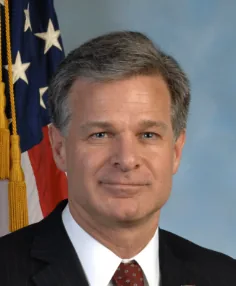
That’s the water in your tap, the power in your walls and the gas that heats your home.
So Washington is building two things at once.
Against missiles, it’s building the Golden Dome, run by General Michael Guetlein, with $17.5 billion requested for next year alone.
Against everything else, it’s building the AI Arsenal.
The Pentagon describes it as hardened data centers on multiple sites, filled with the newest AI chips.
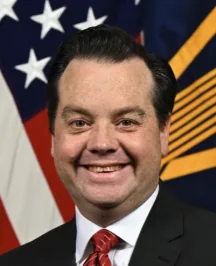
Cameron Stanley told Congress its:
“National Compute Centers will include 100+ Megawatt (MW) scale compute” [and] “will be collocated with Service planned base-level power plants.”
Let me repeat that:
The Pentagon is planning its AI centers around power plants.
Exactly like what Elon has just built… with its own “X-Grid” driven power supply.
And the company that builds and operates the “X-Grid” is central to that.
If history is any indicator, this little-known, federally protected company may soon represent one of the greatest windfalls of our generation.
Here’s why I believe that…
Here’s What Happens When The Government Needs a New Line of Defense
America has had to build a system like this before, one that could see what its enemy was doing.
On May 1, 1960, the Soviets shot down an American U-2 spy plane. Overnight, Washington was blind over the Soviet Union.
It already had a secret program, run by the CIA with the Air Force, to take the pictures from space instead. Washington put a rush on it.
Here’s what “any lengths” looked like. The first camera had gone up in June 1959, and for more than a year every camera Washington launched failed, fell short, or never came back.
It kept launching anyway.
Lockheed, another giant, built the satellite as the prime contractor.
But the camera came from a company almost nobody had heard of. Itek.
It had been founded in late 1957 on a $600,000 loan from Laurance Rockefeller.
On August 18, 1960, a satellite carrying a camera Itek designed went up. 2 days later, an Air Force cargo plane caught its film capsule over the Pacific.
That one capsule, 16 pounds of film, showed more of the Soviet Union than every U-2 flight before it was put together.
Itek went on to build about 200 of those cameras.
Its stock had come out at $2 a share in 1957. Over the next 15 months, while it designed that camera in secret, it hit $255.
Itek: 12,650%
That’s a gain of 12,650%. A $5,000 investment became about $637,500.
Lockheed had its name on the satellite. Itek, the company underneath, made the part the whole program existed to carry.
Now America is building a new way of protecting itself.
And it isn’t strangled by the things that strangled the last ones.
Not a tube, not a chip, not a camera.
It’s strangled by electricity.
The Wall Nobody Can Build Through
A data center is a physical thing.
It has to pull real power off a real grid.
And the grid is out.
Morgan Stanley projects the U.S. will be short 49 gigawatts of electricity for data centers by 2028.

Energy Markets Race to Solve the AI Power Bottleneck
That’s dozens of power plants that don’t exist.
GE Vernova, one of the world’s biggest makers of power-plant equipment, is “taking reservations for 2031 deliveries now,” according to its CEO, as reported by Utility Dive.

GE Vernova gas turbine backlog climbs to 116 GW
GE Vernova is taking reservations for 2031 deliveries now, said CEO Scott Strazik. He spoke of an increasingly diverse customer base, including data centers.
Google now waits up to 12 years to get a new data center hooked up to the grid.
Elon saw this coming years ago.
“The next shortage will be electricity... They won’t be able to find enough electricity to run all the chips.”
He was right.
You can build a chip in months. You can’t build a power grid in months.
And the buyers can’t just build more power plants, because Americans are saying no.
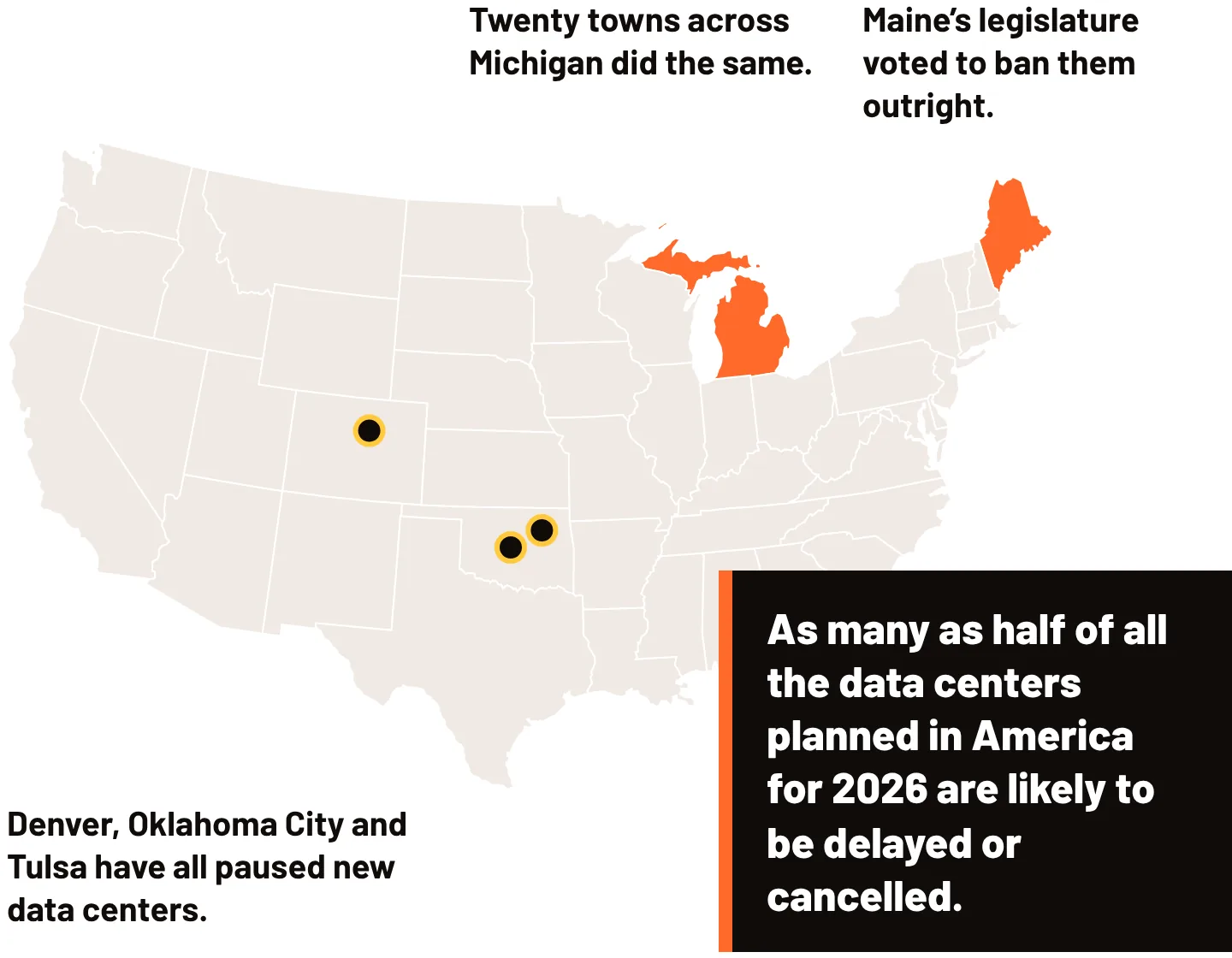
Denver, Oklahoma City and Tulsa have all paused new data centers.
Twenty towns across Michigan did the same.
Maine’s legislature voted to ban them outright.
As many as half of all the data centers planned in America for 2026 are likely to be delayed or cancelled.
Meanwhile, the money keeps coming.
Google, Amazon, Microsoft and Meta plan to spend about $725 billion in 2026, much of it on AI data centers, according to the Financial Times.
And that’s one year.
McKinsey projects data centers will need $6.7 trillion of investment by 2030, with $5.2 trillion of it for AI.
Every one of those buyers has hit the same wall.
And that wall has been a fortune-maker for the folks who understand what’s really going on.
Vertiv builds the power and cooling gear inside the AI data centers.
From its October 2022 low to its May 2026 high, it rose as high as 3,581%.
Bloom Energy puts fuel-cell power plants on site, so a data center can run without waiting for the grid.
From its February 2024 low to its June 2026 high, it rose as high as 3,931%.
The AI Power Bottleneck
Two Stocks That Soared Over 3,500%
Or how about a company I personally recommended to the men and women who follow my research – Powell Industries.
Powell makes the heavy electrical gear that controls the flow of power.
This year it landed a data center order worth more than $400 million, built around power generated right on site.
From its October 2022 low to its May 2026 high, it rose as high as 4,554%.
While all eyes have been on SpaceX, or Nvidia, or Apple, and Meta… the companies that power all of their facilities have flown under the radar.
I believe the biggest of them all has arrived – the company protected by the government, contracted by Elon for 7-years to build the X-Grid in order to power the most critical AI resource in America.
In a second, I’m going to show you how to get the exact name and ticker symbol of that company.
But before we do… you should understand other hyperscalers have realized what Elon is up to.
Elon’s Rivals Are Racing for the Same Thing
Every one of them needs what Elon has.
Google waits 12 years. OpenAI is running its own gas plant in Texas, and Meta runs one in Ohio.
Microsoft’s partner in New Jersey is stuck waiting on an air permit.
Anthropic, one of America’s top AI labs, is renting about 325,000 chips across Elon’s data centers and paying about $1.25 billion a month for them. Google is renting about 110,000 more, for nearly $1 billion a month.
Why would the richest companies on Earth pay Elon billions a month to rent his computer?
Because he has the power and they don’t.
Together, those 2 deals could bring in about $26 billion a year.
That isn’t a bubble.
That’s a gold rush with one mine.
And now the biggest buyer of all, the Pentagon, wants hardened data centers of its own.
So let me show you how far ahead Elon actually is.
Cleanview, a firm that tracks America’s power plants, counted up every data center in the country that generates its own power.
Out of roughly 90 gigawatts that have been announced, about 2 gigawatts are actually running today.
By Cleanview’s count, “the vast majority of that belongs to xAI.” Elon’s two Colossus sites account for 1,498 megawatts of it.
That’s roughly three-quarters of every megawatt of self-generated power running at any AI data center in America. The next-biggest fleet in the country, OpenAI’s site in Texas, is about a quarter the size.
By July 2026, Elon had 69 mobile power units running across the state line in Mississippi, about 1,775 megawatts, enough to rival the largest power plants in the state.
That’s the X-Grid.
Power he can tap today, while Google waits 12 years and GE Vernova takes reservations for 2031.
And it relies on one company – a company most investors have no idea exists… and yet it is the critical energy supplier for Colossus, a machine so important that the Justice Department considers interfering with it a threat to national security. We’ll get to more details about this company in a moment… but there’s a question I think we should address.
“Why Doesn’t Elon Just Build His Own Power?”
Fair question.
After all, Elon builds his own rockets. He builds his own cars, his own AI.
So why not his own power plants?
Because the kind of power plant Elon needs starts with a gas turbine. And right now, nobody can build those fast enough.
GE Vernova, one of the world’s biggest makers, is already taking orders for 2031.
In August, Elon put his finger on the problem himself.
“The limiting factor for nat gas turbine production is casting the blades & vanes”
He is trying. That’s what tells you how short he is.
He bought a power plant overseas and shipped it to America, because he couldn’t get one built here in time.
When an analyst reported it, Elon’s one-word reply was “accurate.”
His rocket company spent about $2.8 billion buying power equipment outright, and it’s building a foundry in Texas to cast its own blades and vanes.
Even that, Elon says, only cuts “up to 18 months” off a line that already runs past 2030.
So he did the one thing that works when the line is years long. He went to a company already at the front of it.
This company already owned the turbines. It had bought its way into the delivery line. And it had the crews to install them and run them around the clock.
So he locked up 7 years of its power, before anyone else could get it, on a take-or-pay contract with a termination payment the company redacted as competitively sensitive, and a stiffer one if he walks away in the first 3 years.
Think about that.
The man who builds his own rockets, cars and AI, who bought a power plant off another continent, still signed a 7-year lock on this company’s power… giving them total control of the X-Grid.
On their terms – not his.
Not even Elon can build around the queue.
And he isn’t the only one trying to get in.
The Company Is Being Carved Up
This company is now building behind-the-meter power for three different hyperscalers, the giant tech companies that run the cloud.
Elon took 7 years of its power.
On April 24, 2026, an affiliate of a global technology company with an investment-grade credit rating signed a 10-year deal for more than 600 megawatts, with an option to extend it another 5 years.
Running flat-out, that’s enough electricity for about half a million American homes.
Another technology customer hired it to build and run an entire power plant, about 660 megawatts, for up to 18 years.
It now has more than 2,000 megawatts under long-term contract. That’s more power than both of Elon’s Colossus sites generate for themselves today.
And every megawatt it signs comes off the market for 7 to 18 years.
Elon got there first. The rest are lining up behind him.
That’s what the X-Grid is really about, and it isn’t one man’s power plant.
It’s a company that can deliver power in months, when everyone else is being told to wait years.
Own it, and you own a piece of the thing Elon couldn’t build fast enough himself.
And it’s locked in for anywhere from 7 years… to 20… as the key energy provider for the machine at the dead center of America’s AI buildout.
With all of that said… let me give you a little background on this company…
I want you to understand why I believe it could soon deliver a gain on the level of a Raytheon… a Texas Instruments… or even an Itek, racing upwards of 12,000%... by powering the X-Grid.
The Company Underneath the X-Grid
So how did a little-known company end up underneath Elon’s X-Grid?
A little over 10 years ago, it started out building equipment for the country’s shale drillers.
It was good business. But it rose and fell with the oil patch.
Then, in July 2024, its management made a bet that changed everything.
It bought a small company that rented out portable power plants.
At the time, that little rental fleet had just 153 megawatts of power. And most of it was already under contract with a big AI company.
Think about the timing.
Elon’s crew switched on the first Colossus, inside a former Electrolux factory in Memphis, that same summer.
The plan was to grow the fleet to 478 megawatts by the fall of 2025.
It blew right past that.
Today, the fleet is headed past 3,000 megawatts, about as much as 3 nuclear reactors generate.
That’s about 20 times where it started.
And the biggest piece of that growth is the deal I’ve been telling you about.
The company controls the venture building the permanent infrastructure behind Elon’s X-Grid.
Running flat-out, that venture could supply about 750,000 American homes.
The equipment is being delivered now, on a 7-year contract.
The plant starts ramping up this quarter and is expected to be fully deployed in the first half of 2027.
That contract runs years past the day Elon’s temporary power has to be gone.
And it’s take-or-pay.
Elon pays whether he uses the power or not.
Washington’s radar had Raytheon behind it, and its spy satellite had Itek. Its missile had Texas Instruments.
The X-Grid has this company.
If you own it, you own a piece of that contract.
And it gets better…
Why This Company Is Different
In the 1920s, Henry Ford built the River Rouge plant outside Detroit.
Iron ore and coal went in one end. Finished cars came out the other.
Ford controlled every step, from the raw materials to the finished car.
Now look at the company I’m recommending today.
From the turbine to the plug, this company can handle the whole job.
It controls Elon’s X-Grid from top to bottom.
That matters, because an AI data center can’t wait years for power.
Its customers can call one company instead of waiting on the grid.
This summer it bought 2 more companies to bring even more of the construction work in-house. Its workforce has grown from 468 people to more than 2,100. Not power the way your utility sells it. Power in months, when everyone else is being told to wait years.
Remember Raytheon, Texas Instruments and Itek. Each one got what Washington hands out when it’s in a bind, a factory, a contract, a program that wasn’t allowed to fail.
This company is signed on to the one buildout the United States government has gone to court to protect.
Here’s what that could mean for you…
Elon’s 1,000% AI Power Stock
This isn’t a bet on power that might show up someday.
Nearly 3 of every 4 dollars this company brings in now come from power. Of the 3,000-plus megawatts it’s headed for, about 950 are already earning money, roughly one nuclear reactor’s worth of power paying the bills today.
And the money is coming in faster than even management expected.
On August 5, the company raised its forecast. 34 days later, on September 8, it raised it again.
Its adjusted EBITDA, the number Wall Street uses to measure what a business earns from its operations, jumped about 29% in a single quarter, to a pace of about $433 million a year. By the first quarter of 2027, the company expects about double that.
a year
jumped about 29% in a single quarter
And it’s coming in on long contracts, from 7 years to as long as 18.
A baby born today would be finishing high school before the longest one runs out.
That’s the kind of revenue Wall Street usually pays up for, once it notices. I don’t believe it has yet.
I suspect many investors still see this company as the shale-field supplier it used to be.
Look at GE Vernova. When GE spun off its energy business on April 2, 2024, it closed its first day at $140.
Then the AI power rush hit, and the market started treating it as an AI power stock. It went as high as $1,174.86 on June 30, 2026, a gain of 739%.
I believe this company is about to be reclassified the same way, from oil-patch supplier to AI power company, with a 7-year power contract behind the AI the Pentagon swears by.
Even a 400% move from here would turn $5,000 into $25,000. I’ll show you the full math shortly.
But I want you positioned before December 11th.
To see why, look at what the Pentagon is asking Congress for…
$46 Billion, Pointed at the X-Grid
The Pentagon’s own budget calls it “historic.”
$58.5 billion for artificial intelligence, inside the biggest military budget ever requested, $1.5 trillion for next year alone.
And $46 billion of it is for one thing.
A “sovereign AI Arsenal” of hardened data centers packed with GPUs.
That makes the AI Arsenal the second-largest program in the Pentagon’s entire $350 billion war chest of new money.
It’s bigger than Golden Dome, and 20 times what the Pentagon is asking for Maven, the targeting system behind the Iran strikes.
The first $29.5 billion is in this year’s request.
And read what the money buys, in the Pentagon’s own budget documents.
“Electrical infrastructure.” “Rack power distribution.” Compute centers “collocated with Service planned base-level power plants.”
Cameron Stanley told Congress the thing holding the military back is compute.
And compute is power.
The Pentagon can’t spend a dollar of it before December 11th.
But when it does, there are only two ways to go.
If the Pentagon builds, it needs power delivered in months, not years.
That’s what the X-Grid company does.
And one company controls every nut and bolt… and every watt of electricity… that flows through it.
The Pentagon has already told you what it thinks of Elon’s AI.
The title of its own press release, from December 22, 2025, reads:

The War Department to Expand AI Arsenal on GenAI.mil With xAI
The Pentagon’s own words. Its AI Arsenal, expanded with Elon.
Built on the back of the X-Grid.
And here’s one more thing…
It’s Already Written Into Law
The White House’s AI Action Plan calls AI a race America has to win.
In January 2026, the Pentagon’s own AI strategy ordered the military to become an “AI-first” warfighting force. It says “speed wins.”
The defense law Congress passed in December 2025 goes further.
It orders the Pentagon to report by March 1, 2027 on every data center it plans to build on a military base, including “assessments of projected electricity and water usage requirements” for each one.
It orders the Navy to find bases where nuclear reactors “could be co-located with a data center.”
In other words, the law is asking how much more computing power the military needs, and how much electricity it will take.
The government has picked its direction. And the money is following it.
The X-Grid’s Nuclear Option
Here’s the kicker.
In June 2026, the X-Grid company took a stake in a Texas startup building nuclear reactors the size of a shipping container.
That same month, the startup’s reactor achieved a self-sustaining nuclear chain reaction at Idaho National Laboratory, under federal authorization.
The Department of Energy called it...
“The third DOE-authorized advanced reactor to go critical by the July 4th deadline set by President Trump in his May 2025 executive order.”
Department of Energy
It went from project kick-off to functioning and active in roughly 150 days.
Other orders Trump signed in May 2025 direct the Army to have a nuclear reactor running on a military base by September 30, 2028.
And they set aside 20 metric tons of nuclear fuel for reactors like this one, in the government’s words, “for the purpose of powering AI and other infrastructure.”
The startup says it’s building for data centers and defense.
Its next test, at full power, is set for 2027.
And this company – the firm building the X-Grid – has signed on to help bring those nuclear reactors to market.
I believe this is the next stage: that in short order, the X-grid will soon become Elon’s own nuclear power supply.
So Why Not Just Buy SpaceX?
So with all of this said, maybe you’re wondering why not just buy SpaceX?
Fair enough. You might do fine.
But SpaceX has already made its big move.
It came out of its IPO worth about $2 trillion, one of the most valuable companies on Earth, with a market value bigger than the entire economy of most countries.
For SpaceX to hand you 1,000% from here, it would have to grow into a $22 trillion company.
And here’s what almost nobody buying SpaceX understands:
The permanent power behind its most critical piece of infrastructure, the X-Grid, is in the hands of a company 99% of investors have no idea exists.
We’ve seen this before, with another giant.
In January 1958, the Air Force issued the contract for the B-70, a bomber built to fly at 3 times the speed of sound. The computer that would guide it went to the biggest name in computers, IBM.
IBM had a problem. The computer’s memory needed a silicon transistor powerful enough to drive it, and IBM couldn’t get one from any of its regular suppliers.
So in February 1958, IBM placed an order with 8 engineers in California who had started their company the year before and hadn’t built a single device. 100 transistors, at $150 apiece.
The company was Fairchild Semiconductor. The IBM order was its first sale.
IBM’s shareholders did fine. But look at what happened to the company underneath.
Its parent, Fairchild Camera and Instrument, traded on the American Stock Exchange. In July 1958, the month those first transistors shipped to IBM, its stock closed at $23.75 a share.
On July 1, 1960, those same shares were worth $386, counting a 2-for-1 split.
Fairchild: 16 times your money in 2 years
That’s a gain of 1,525%. A $5,000 investment became about $81,000 in 2 years.
All because the government needed what IBM had, and IBM could only build it with Fairchild.
And the 8 engineers who got that order went on to seed Silicon Valley.
Two of them, Robert Noyce and Gordon Moore, left to found Intel.
I believe the X-Grid is the same story.
I believe this little-known company is building a power supply so vital it becomes the lifeblood of the AI buildout.
And the government agrees.
It has defended that power in federal court as, in the Pentagon’s own sworn words, “a matter of paramount national security.”
SpaceX has its name on the rockets, and on Colossus. The company underneath has the part SpaceX couldn’t build fast enough itself.
The company underneath is hundreds of times smaller. The same dollars move a small company a lot further.
That’s the gap.
And a wave of SpaceX money is about to come loose.
When SpaceX went public in June, its employees and early investors were barred from selling most of their shares. Since August, those shares have been freed in stages.
On December 8th, the last of those 6-month lockups ends.
By The Motley Fool’s count, nearly 6 billion SpaceX shares are being freed before Elon can sell a single one of his own, in June 2027. At SpaceX’s early-October share price, that’s close to $1 trillion of stock.

Elon Musk Can't Sell SpaceX Stock Until June 2027 -- But 6 Billion More Shares Could Flood the Market Before Then
When a lockup ends, a lot of insiders cash out. And that money has to go somewhere.
I believe some of the smartest of it goes looking for the company underneath the X-Grid. After all, SpaceX’s own people know exactly what Colossus runs on.
And the time to get positioned in it is right now, before December 11th.
The Smart Money Is Already Buying the X-Grid Stock
I’m not the only one who’s noticed.
Yes, there’s been plenty of buying in SpaceX. A lot of it is forced.
The Nasdaq-100 added SpaceX on July 7, 2026, and the Russell 1000 took it in June.
So every index fund that tracks those indexes has to own it, whether the manager likes the price or not.
Nobody is forced to buy the X-Grid stock. The people buying it are choosing to.
Start with the people who know the company best.
On September 9, 2025, its chairman and CEO bought 10,000 shares with his own money.
The same day, the company’s president bought 2,000 more.
In December 2025, the company’s co-CEO bought $150,000 worth of shares.
And one of its directors has been on a buying spree.
$199,000 in December 2025, and $451,000 in May 2026.
Then on September 8, 2026, another $501,000.
That’s more than $1.1 million of one director’s own money in 9 months, the last of it in September.
Now look at the institutions.
On June 30, 2025, 227 professional money managers reported owning this stock.
On June 30, 2026, it was 458.
The number of funds holding it doubled in 12 months.
BlackRock, the largest asset manager on Earth, went from 7% of the company at the end of June to 13.1% by the end of July.
It nearly doubled its stake in a single month.
And that’s on top of the $175 million of the company’s convertible notes BlackRock had already bought.
On July 15, 2026, Standard & Poor’s added it to the S&P SmallCap 600.
Then there’s Wall Street itself.
Morgan Stanley started covering it last December, and Needham started in June.
Wolfe Research started in July with a target for the company to nearly double, and Wells Fargo upgraded it in August.
In September alone, Barclays, Citi, Stifel, Northland and Raymond James all raised their price targets.
Today, 14 analysts cover this stock, and every one of them rates it a Buy.
Insiders are buying with their own money.
The biggest fund manager on Earth nearly doubled its stake.
Standard & Poor’s added it to its index this summer.
That’s what the smart money is doing, while most individual investors have never heard the company’s name.
With all that said… let me give you a glimpse of what I think this could be worth very, very soon.
Here’s the Math
I can’t promise you specific returns. Nobody can.
But I can show you what’s happened before, when a small company sat behind something Washington had decided it had to have.
If this company matched GE Vernova’s 739%, a $5,000 position could grow to about $41,950.
If it only reaches the 1,000% I believe is possible over the next 12 months, that $5,000 could become $55,000.
If it matched Rocket Lab’s 3,800%, that $5,000 could become about $195,000.
If it matched Raytheon’s 9,980%, that $5,000 could become about $504,000.
Itek did 12,650% in 15 months, once Washington needed what it made.
What Could $5,000 Become?
Here’s what I know.
The Pentagon is asking Congress for the first $29.5 billion of its $46 billion plan. Colossus is already running, and the United States government is defending its power supply in court.
And the plant behind the X-Grid’s 7-year contract is being bolted down right now.
The biggest risk isn’t buying this stock.
The biggest risk is sitting on the sidelines while the rest of the market figures out what you already know.
Get positioned before December 11th, and you’re in before the Pentagon’s money moves.
Everything Is in This Report
I’ve put every detail into a special report called:
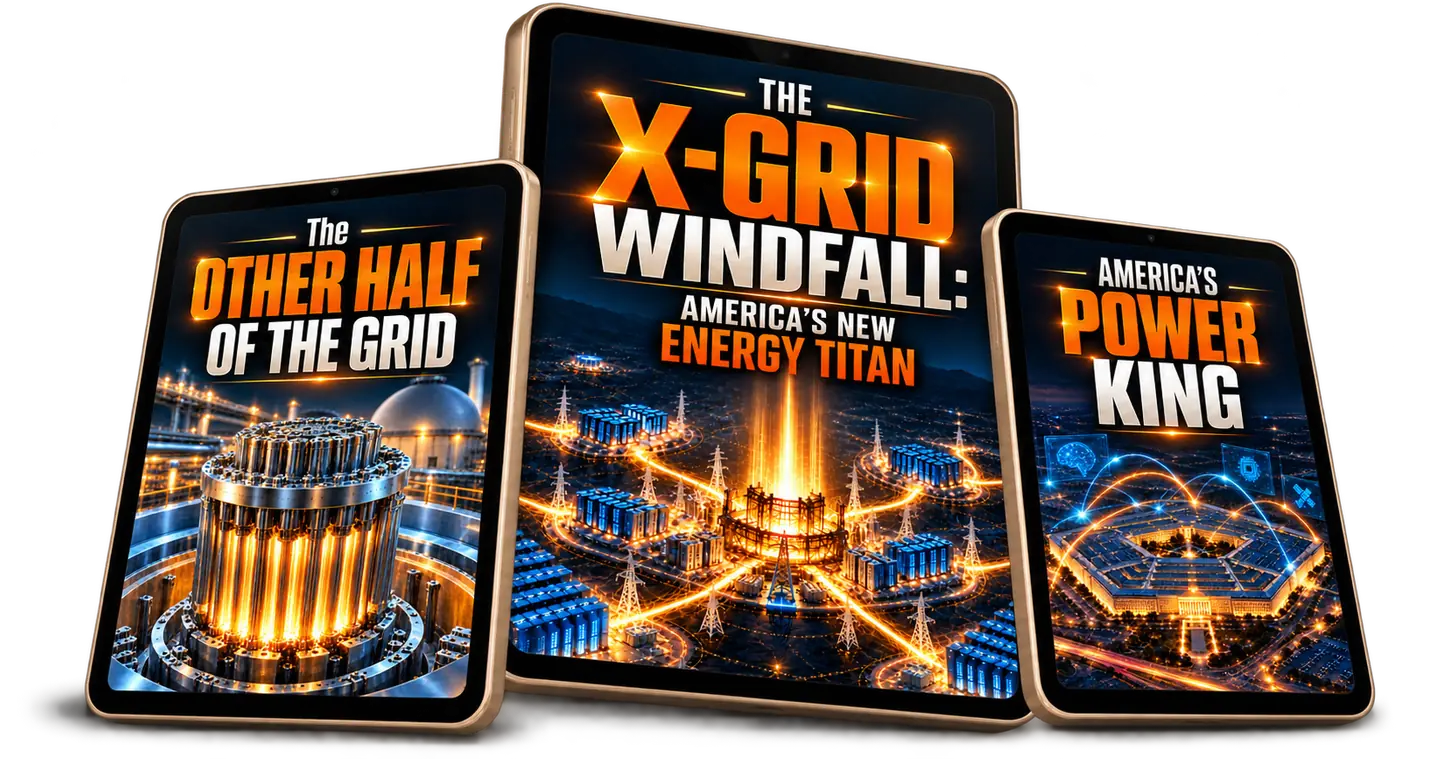
“The X-Grid Windfall: America’s New Energy Titan”
Inside you’ll find the company name, the ticker symbol, my specific buy-up-to price, a full breakdown of its contracts, its catalysts and its risks, and my analysis of how high this stock could go.
And I want to send it to you today, absolutely free, the moment you join me.
Now, the obvious question. Why would I do this?
Simple. I spent 30 years inside the rooms where the real money gets made, and I learned that the best ideas go to the biggest clients first.
By the time an idea reaches the everyday investor, the easy money is gone.
That’s why I left Wall Street and started Behind the Markets. A research firm that answers to nobody but the people who read it.
So when I find something like the company underneath the X-Grid, I don’t have to whisper it to a hedge fund first.
I send it straight to you.
All I ask in return is that you give me research a try.
Introducing Behind the Markets

Behind the Markets is my investment research service.
It’s where I publish my best ideas, the ones I believe have the best chance of delivering outsized returns.
When you join today, you’ll get:
My model portfolio, with every open position, buy-up-to prices and sell targets.
Monthly market briefings, with my analysis of what’s moving markets and where the opportunities are.
Flash alerts, real-time updates when it’s time to buy, sell or adjust a position.
Full access to every special report in the archive.
And direct access to my research team if you ever have a question.
Two More Reports, Free
I’ve also prepared 2 bonus reports to give you every angle on this opportunity.
Bonus Report #1: “The Other Half of the Grid”
Gas is how the X-Grid gets built today. Nuclear is what comes after it.
Remember those 20 metric tons of nuclear fuel Washington set aside “for the purpose of powering AI”?
That fuel is called HALEU, and most of the advanced reactors being designed today will need it.
In 2021, one company’s plant became the only one in America licensed to make it.
This report names that company and shows you why I believe it holds the key to the next half of America’s AI power.
Bonus Report #2: “America’s Power King”
I believe the Pentagon’s AI buildout is coming. Everything I’ve shown you today points that way.
But I’ve been doing this long enough to know that timelines stretch.
So I found a stock I believe profits through any slowdowns, through any delay.
It’s my Plan B.
It runs about 140,000 miles of pipeline, one of the biggest energy networks in America.
And the AI buildout isn’t waiting on Congress.
In January 2026, this company started delivering power to Oracle’s data center near Abilene, Texas, the first of 3 Oracle data centers it has signed on to supply.
If the Pentagon’s money is delayed, America’s AI data centers still need fuel.
It’s the insurance policy I want every reader of this report to own.
All 3 reports are yours free when you join Behind the Markets today.
Your Price Today
A one-year membership to Behind the Markets normally costs $399.
But because I believe this is one of the most important opportunities I’ve ever published, and because I want as many serious investors as possible positioned before December 11th, I’m offering a founding member rate.
$49 for your first full year.
That’s about 13 cents a day.
Less than dinner for two at a decent restaurant. Less than a couple of months of the streaming services you forget to cancel.
For a full year of research, alerts and access, plus 3 special reports on what I believe is one of the most important investment stories of the decade.
My 6-Month Guarantee

I’m so confident in what I’m about to send you that I’m putting the risk on myself.
Join Behind the Markets today.
Read the reports. Study the research.
Watch how I handle every recommendation, for 6 full months.
If at any point during those 6 months you decide Behind the Markets isn’t for you, for any reason or no reason at all, just contact my customer care team or send one email.
We’ll refund every penny of your $49.
No hoops to jump through. No hard feelings.
And the 3 special reports? They’re yours to keep, either way.
I’m putting 30 years of reputation on the line.
And it’s not just my word you’re taking.
“I’ve been following Dylan’s recommendations for almost 20 years. His best idea made me almost 7 times my original investment.”
Now, before you click the button below, let me answer the 2 questions I know you’re asking.
“Isn’t this stock too risky for my portfolio?”
I understand the worry. But look at what this company has already locked in.
Its power is committed under long-term contracts that run from 7 years to as long as 18.
Its long-term customers include affiliates of investment-grade technology companies.
The deal tied to Elon’s AI is take-or-pay, with a termination payment if Elon ever walks away.
Management has raised its outlook twice since August.
And let’s not forget…
The government has stepped into court and fought for Elon’s X-Grid…
It told the court that shutting off the X-Grid’s power threatens America’s national security.
When Uncle Sam sends his own lawyers to protect the X-Grid, that’s a tailwind I want behind me.
And the company I’m recommending controls every inch of the project.
“Am I too late?”
The permanent plant behind the X-Grid is still being delivered and switched on, through the first half of 2027.
Not only that, but the last of SpaceX’s 6-month insider lockups doesn’t end until December 8th… and the ban on new Pentagon programs runs until December 11th.
The company is guiding to about double its second-quarter adjusted EBITDA by the first quarter of 2027.
I believe the biggest move is still ahead.
You still have time – but there’s no question the clock is ticking as we speak.
Here’s what happens when you click the button below.
You’ll go to a secure order page. It takes about 60 seconds.
The moment your order is confirmed, you’ll get immediate access to your 3 special reports, including the company name, ticker symbol and my buy-up-to price.
You’ll be added to the Behind the Markets membership. And you’ll be locked in at the founding member rate of $49 for your first full year.
But you have to act fast.
Why December 11th?
Because that’s the day the Pentagon’s money gets loose.
Here’s what I mean.
On September 2, 2026, President Trump signed a stopgap spending law.
It keeps the federal government funded only through December 11, 2026.
And it comes with strings. It bars the Pentagon from starting new programs. It bars new production. It bars any project that wasn’t already funded last year.
The AI Arsenal is exactly that kind of new program.
As I read it, as long as that stopgap law is in charge, the first $29.5 billion of the Pentagon’s AI Arsenal can’t get started.
And Congress still hasn’t passed a full-year defense budget.
A House committee approved its version in June. As of this writing, neither the full House nor the Senate has passed it.
December 11th is the day that stopgap law runs out.
Congress has to act by then.
Once it passes that budget, the ban is gone, and the Pentagon’s hands come untied.
And Elon has a deadline of his own.
Every temporary turbine powering Colossus 2 has to be shut off by July 14, 2027, and the permanent power has to be carrying the load by then.
That gives Elon until next summer to replace the power Colossus runs on.
And the company I’ve shown you controls the entire project, on a contract that runs years past the shut-off date.
Congress has to act by December 11th
SEPTEMBER 2, 2026
Stopgap signed
DECEMBER 8, 2026
Last SpaceX’s lockups ends
December 11th
Stopgap law runs out
July 14, 2027
Temporary turbines shut off
When $46 billion gets pointed at one thing, it rarely sits still. It goes looking for the companies that can deliver, usually the ones already delivering.
In my opinion, a big piece of it lands on the power behind the data centers.
Starting with the company that supplies the X-Grid.
The Pentagon can’t move a dollar of it until December 11th.
You don’t have to wait.
You can own the company underneath the X-Grid before the Pentagon’s money arrives.
That’s why I want you in before December 11th.
You Have Two Choices
When we started this message, Cameron Stanley’s sworn statement was a secret to you.
Now you’ve seen what’s inside.
A computer the Pentagon swore helped it hit 2,000 targets in 96 hours.
A private power grid keeping it alive, with the United States government standing in front of it.
And one small company with a 7-year contract to supply it.
That leaves you with two choices.
The first is to walk away. Close this page, forget the filing, and let December 11th come and go.
And find out next year how far the company underneath the X-Grid ran while you sat it out.
The second choice takes about 60 seconds.
Click the button below and lock in your founding member rate.
And “The X-Grid Windfall: America’s New Energy Titan” lands in your inbox before you finish your coffee.
One Last Thing
Still here? Good.
That tells me you read the evidence before you act.
So let me tell you two things I held back.
This summer, SpaceX disclosed a $6.7 billion computing contract, separate from the rental deals I mentioned.
It covers 6 months, and its CFO said it would start ramping up.
Then, on September 10, its CFO disclosed another deal, about $1.1 billion a month, starting December 1.
SpaceX hasn’t named either customer. Some analysts have speculated the Defense Department is one of them, and that’s unconfirmed.
And remember, by The Wall Street Journal’s account, SpaceX has been in talks to rent the Pentagon billions of dollars’ worth of AI computing power. As of this writing, I haven’t seen any sign it’s been signed.
If either deal turns out to be the Pentagon, I believe the power that runs Colossus becomes even more valuable.
And I don’t believe any of it is priced into the company I’ve been telling you about.
Let me leave you with the timeline.
SEPTEMBER 2, 2024
On September 2, 2024, Elon announced that Colossus was running, built in just 122 days.
FEBRUARY 23, 2026
On February 23, 2026, word broke that the Pentagon had cleared Elon’s AI for its classified systems.
FEBRUARY 28, 2026
On February 28, 2026, the strikes on Iran began. During those strikes, U.S. forces hit 2,000 targets in just 96 hours.
JUNE 15, 2026
On June 15, 2026, Cameron Stanley swore to a federal court that Elon’s AI supports “targeting.” The same day, the United States government filed to take over the lawsuit against Elon’s power and kill it.
JULY 30, 2026
On July 30, 2026, Mississippi signed an order giving Elon more time to run his temporary power.
AUGUST 31, 2026
On August 31, 2026, the Department of War switched Elon’s AI on across the force.
SEPTEMBER 18, 2026
On September 18, 2026, the government took the fight over Elon’s power to the Fifth Circuit.
DECEMBER 8, 2026
On December 8, 2026, the last of SpaceX’s 6-month insider lockups ends. And those insiders know exactly what Colossus runs on.
DECEMBER 11, 2026
ON DECEMBER 11, 2026, THE BAN ON NEW PENTAGON PROGRAMS IS SET TO RUN OUT.
End of 2026
By the end of 2026, the permanent plant behind the X-Grid starts switching on.
July 14, 2027
And by July 14, 2027, every temporary turbine at Colossus 2 has to be gone.
Between an old appliance factory in Memphis and a federal courtroom, I believe Colossus went from chatbot to weapon of war.
That’s the Alliance. Elon and the United States military, with one small company supplying the power source they need to build what I think will one day be considered the 7th branch of the United States Military.
When Washington needs a company, it goes to any lengths to protect it.
You saw how it sent Fairchild roaring 1,525% – every $5,000 became $81,000.
How Texas Instruments catapulted 3,990% – every $5,000 became $204,500.
Or Raytheon soaring 9,980%… enough to turn every $5,000 into $504,000.
And then there was Itek, rocketing 12,650% – turning every $5,000 into $637,500.
What Every $5,000 Became
Fairchild Semiconductor
1,525%
▲ GAIN
Texas Instruments
3,990%
▲ GAIN
Raytheon
9,980%
▲ GAIN
Itek
12,650%
▲ GAIN
It’s happening again right now.
The company building and powering Elon’s X-Grid has become critical to America’s national defense…
They’re being vouched for by the U.S. government.
And countless other AI giants are knocking on Elon’s door just to grab some of the power the X-Grid is generating for him.
And now the clock is ticking toward December 11th.
Click the button below.
Get the name and ticker.
Read the research.
And if I’m wrong, you’re covered by my 6-month guarantee.
But if I’m right, and I believe I am, you’ll look back on this moment and know you were early.
Sincerely,